


Episode 3
Resonance Without Pulse
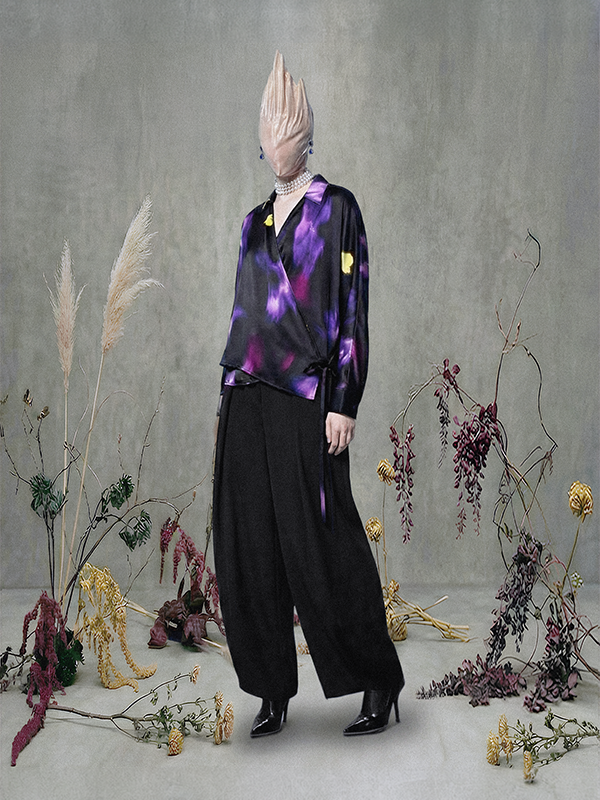
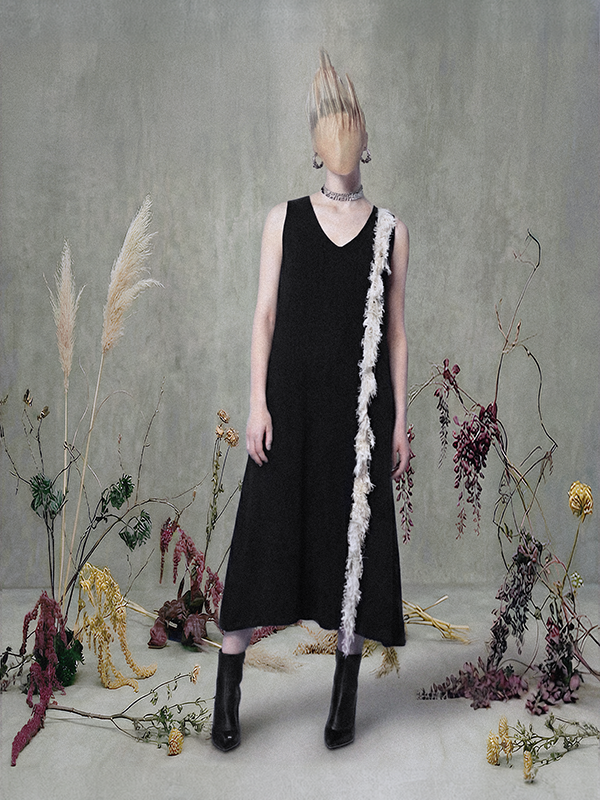
This collection begins with the reconfiguration of inherited forms and the traces left by time.
The family crest Narabi Taka is dismantled and reconstructed as a contemporary graphic.
Forms rooted in the kimono are translated into the structural framework of garments through the relationship between body and time.
In The Work of Art in the Age of Mechanical Reproduction, Walter Benjamin argues that when an artwork becomes mechanically reproducible, its “aura” (uniqueness) declines. His analysis is widely referenced as a foundational theory in art history and visual culture studies. What is important here is his observation that, as reproduction advances, the origin and attribution of the work become unstable.
For ASATO, the trace of suturing (healing) is a physical record that emerges from the intersection of experience and the body.
Originally, it belonged to a specific body and time, and its attribution functioned as evidence of singularity that cannot be transferred to others.
However, in an environment where forms become reproducible and traces are shared and circulated, such attribution becomes difficult to define clearly. Forms proliferate, and visual homogenization progresses. This does not necessarily mean the disappearance of individuality. In this collection, traces and memories that once belonged to the body are repositioned within a visual environment detached from the body.
What is questioned here are the conditions under which attribution is established and how it can be interpreted.“Resonance Without Pulse” refers to the state in which a trace continues to resonate even as the certainty of its attribution is lost.
It marks the moment when the materiality and universality of the trace appear simultaneously.











.webp)
